Wednesday, March 28, 2007
Descartes on teaching
"My present design, then, is not to teach the method which each ought to follow for the right conduct of his reason, but solely to describe the way in which I have endeavored to conduct my own. They who set themselves to give precepts must of course regard themselves as possessed of greater skill than those to whom they prescribe; and if they err in the slightest particular, they subject themselves to censure." (Discourse de la methode)


Sunday, March 25, 2007
altruism
I am reading one of those "self-help" books because I am interested on how to manage challenging projects. The book is called "7 habits of highly effective people", and up to now, the main message is to have high values and respect for life and other people's life. I guess translated to biological, evolutionary terms, this means of giving way to altruism, but not faked altruism to make "fast progress". Anyway, life is challenging for sure, even more so, if you try to involve with science.
Here a quote by Werner Heisenberg:
"What we observe is not nature itself, but nature exposed to our method of questioning."
(hmm..... designing a programming language that help us switch questions and models more easily, that is something I am thinking on lately.)
Here a quote by Werner Heisenberg:
"What we observe is not nature itself, but nature exposed to our method of questioning."
(hmm..... designing a programming language that help us switch questions and models more easily, that is something I am thinking on lately.)
Friday, March 23, 2007
On imagination
I have the suspicion that imagination works best, when leaving it alone, i.e. is fueled by laziness. There is a saying: "Laziness stimulates the engineering creativity." - I found this interesting with respect to the following quote by John Backus, one of the early designers of programming languages:
By the way, I am wondering who is reading this blog. As the blogspot.com commenting did not work satisfactorily, you might want to contact me at mulder DOT patrick AT gmail DOT com
"Much of my work has come from being lazy. I didn't like writing programs, and so, when I was working on the IBM 701 (an early computer), writing programs for computing missile trajectories, I started work on a programming system to make it easier to write programs,"
By the way, I am wondering who is reading this blog. As the blogspot.com commenting did not work satisfactorily, you might want to contact me at mulder DOT patrick AT gmail DOT com
Thursday, March 22, 2007
more on music
personally, I am not a fan of heavy-guitar music (well, better, I stopped being a fan of heavy-metal 10 years ago, I stopped being a fan of most popular, electronic music around 3 years ago)
for the ones who need an excuse for heavy-metal music:
Stress
for the ones who need an excuse for heavy-metal music:
Stress
Narratives
When listening to music, it is interesting to think on how different tones in a tonal scale can take different functions, as if certain tones exert more gravity than others. The different functions of the same tones in different contexts can also be seen in a theater for example, where the same actors (tones) can play different roles (gravity) depending on the theater piece (tonal scale).
People need good narratives to work or play.
People need good narratives to work or play.
Tuesday, March 20, 2007
simplicity and complexity
I am just thinking that a system to represent multiple things at once (via equations, movements, sounds, light effects) would be great. the system should be as easily accessible like listening to music, and like good music, gradually increasing complexity.
hope to start programming on this sort of system soon.
hope to start programming on this sort of system soon.
Monday, March 12, 2007
Meta-mathematics
I have been reading about the problems of deductive and formal reasoning and lately finished the book on Goedel's proof by Nagel and Newman.
It got clear to me, that for every formal system, there exists a meta-system that can be derived (or used) to help to understand the nature of the original formal system. Some point out, that for intelligence, you would need to have meta-intelligence to derive understanding of what intelligence is. Some conclude further, that the meta-intelligence is "god" and can not be understood by intelligence. Somehow this is circular reasoning, and will not give "better" memes. What can be derived from this sort of reasoning however is some reaction we humans show to inconsistent reasoning. Meta-control mechanisms (= emotions) will point out that some processes are wasting time. See also a quote Marvin made in the newsgroup comp.ai.philosophy:
"I think that I've said before, that philosophy is mostly bad psychology. The most common reaction that "normal" people have to such propositions is -- after a few moments of thought -- to LAUGH! This is because, I'm sure, that the detection of absurdities (which include both asserting inconsistent propositions and exhibiting tabooed views of certain body-parts) activates certain brain centers that are used to prevent the rest of the brain from continuing normal reasoning. In other words, the machinery that prevents you from "taking it seriously". There's some more about this in chapter 27 of The Society of Mind.
Classical monotonic consistent logic was one of the first good ideas that came with the era of modern technical thinking about thinking. It came in the infancy of what we now call cognitive science. Philosophers played an important role in developing it.
Today that young organism, cognitive science, is approach puberty or, perhaps, middle age. Philosophers, it seems to me, with the exception of Dennet, Sloman, and a very few others, are fixated in that infantile stage. "
It got clear to me, that for every formal system, there exists a meta-system that can be derived (or used) to help to understand the nature of the original formal system. Some point out, that for intelligence, you would need to have meta-intelligence to derive understanding of what intelligence is. Some conclude further, that the meta-intelligence is "god" and can not be understood by intelligence. Somehow this is circular reasoning, and will not give "better" memes. What can be derived from this sort of reasoning however is some reaction we humans show to inconsistent reasoning. Meta-control mechanisms (= emotions) will point out that some processes are wasting time. See also a quote Marvin made in the newsgroup comp.ai.philosophy:
"I think that I've said before, that philosophy is mostly bad psychology. The most common reaction that "normal" people have to such propositions is -- after a few moments of thought -- to LAUGH! This is because, I'm sure, that the detection of absurdities (which include both asserting inconsistent propositions and exhibiting tabooed views of certain body-parts) activates certain brain centers that are used to prevent the rest of the brain from continuing normal reasoning. In other words, the machinery that prevents you from "taking it seriously". There's some more about this in chapter 27 of The Society of Mind.
Classical monotonic consistent logic was one of the first good ideas that came with the era of modern technical thinking about thinking. It came in the infancy of what we now call cognitive science. Philosophers played an important role in developing it.
Today that young organism, cognitive science, is approach puberty or, perhaps, middle age. Philosophers, it seems to me, with the exception of Dennet, Sloman, and a very few others, are fixated in that infantile stage. "
Thursday, March 08, 2007
Developping ideas
This weekend, I finished reading the book "The Selfish Gene" by Richard Dawkins. It was very impressive to think about the complexity and similarities between species, and how we inherit shapes and functions from one generation to the next. Dawkins argues that similar to the alphabet of life, our human brains can transmit words and ideas coded in an alphabet of "memes", replicators on an abstract level in our brains that are competing for communication channels (the internet is an incredible rich meme-pool, so is the television, a newspaper and a patent office).
All in all, I am thinking that ideas share some abstract features with computer programs, that use the roles of functions and expressions for coding change. At least, good ideas often (always ?) address some useful changes. And indeed, I would agree with John Maeda, that to develop those meme programs inside one owns mind, it is needed to look at these processes and programs and try to ban the critics and imprimers from guiding you. (There is a saying from Marvin Minsky: "Never listen to your critics. Don't even ignore them.")
All in all, I am thinking that ideas share some abstract features with computer programs, that use the roles of functions and expressions for coding change. At least, good ideas often (always ?) address some useful changes. And indeed, I would agree with John Maeda, that to develop those meme programs inside one owns mind, it is needed to look at these processes and programs and try to ban the critics and imprimers from guiding you. (There is a saying from Marvin Minsky: "Never listen to your critics. Don't even ignore them.")
Monday, March 05, 2007
Returns and success
During the lunch we had some discussion on the merits of socialism in education, i.e. that everyone should have the opportunity to learn whatever (s)he likes and as such can improve her/his personal understanding ("personal" is opposed to "socialism", but let's assume that the value of minds under development are equal)
The discussion turnt to the enormous endowments some universities have, and how they manage their financial assets to provide this sort of intellectual freedom for new ways of learning. I found an interesting article on the investment manager of Yale university, with an intersting advice on returns vs. making money1:
(1) http://www.nytimes.com/2007/02/18/business/yourmoney/18swensen.html
The discussion turnt to the enormous endowments some universities have, and how they manage their financial assets to provide this sort of intellectual freedom for new ways of learning. I found an interesting article on the investment manager of Yale university, with an intersting advice on returns vs. making money1:
"What he demands of himself is exactly what he demands of the custodians of Yale’s capital: 'People who define success by generating great returns, not by making as much money as they possibly can,' he says. "
(1) http://www.nytimes.com/2007/02/18/business/yourmoney/18swensen.html
Sunday, February 25, 2007
26 letters
This morning, I saw some interesting paintings of Jan Brueghel the older in the "Alte Pinakothek". I was drawn to a painting displaying a sermon including a large crowd of interested people. In the front, near the preacher, there were obviously some women, in the back there were some people with guns, maybe some soldiers or some hunters returning home. It was striking to me how peaceful the crowd of mixed people was standing there, listening to the words of the philosopher. That we see lectures like this also in our modern world might be related to our needs for hope, the hope for a better life, the hope to find better meaning of our existence, the hope to prevent disappointment, or the hope to solve conflicts between people. It is interesting to see how languages and words can unify or split groups of people so heavily. Words can be instruments for power or seduction, but equally, they can transport the most interesting secrets of the world we live in. All with 26 letters.

(another interesting picture concerning a Brueghel painting.... found somewhere on the internet by googling. besides the 26 letters of the alphabet for normal writing, it is interesting to think about the 4 letters of the DNA for writing the sources of life.)

(another interesting picture concerning a Brueghel painting.... found somewhere on the internet by googling. besides the 26 letters of the alphabet for normal writing, it is interesting to think about the 4 letters of the DNA for writing the sources of life.)
Tuesday, February 20, 2007
Russell's Paradox
"Nothing contains everything", applied:
A man of Seville is shaved by the Barber of Seville if and only if the man does not shave himself. Does the barber shave himself ?
* If the barber does not shave himself, he must abide by the rule and shave himself.
* If he does shave himself, according to the rule he will not shave himself.
And, another one:
"One of themselves, even a prophet of their own, said, the Cretians are alway liars, evil beasts, slow bellies. This testimony is true."
Titus 1:12-14 (King James Version)
A man of Seville is shaved by the Barber of Seville if and only if the man does not shave himself. Does the barber shave himself ?
* If the barber does not shave himself, he must abide by the rule and shave himself.
* If he does shave himself, according to the rule he will not shave himself.
And, another one:
"One of themselves, even a prophet of their own, said, the Cretians are alway liars, evil beasts, slow bellies. This testimony is true."
Titus 1:12-14 (King James Version)
Sunday, February 18, 2007
Automata
In the sense of this post, "automaton" is an abstract concept. It is not used such, that an element which can be explained by the automata concept, equals this concept. There is often large resistance to the idea that the working of minds or living processes in general can be explained by deductive reasoning, as by mathematical deduction of patterns. Still, it is my impression, that the concept of automata or virtual machines is very useful to predict certain patterns in our minds, or to explain the behavior of complicated, mechanical interactions, or to improve our use for processes in our "imagination" or learning. Daniel Dennett mentions that automata make the basic building blocks of our souls - although the resulting system is very complicated which maybe does not allow to use the automata concept for the soul itself. (Dennett: "Si, abbiamo un anima, ma e fatto di tanto picolo robots", "Yes, we have a soul, but is made from lots of tiny robots.") Marvin Minsky expresses the automata as agents or "ways to think" or "emotions".
Friday, February 16, 2007
Innovation !
Hello,
there is another quote by Alan Kay which I like:
"The best way of predicting the future is to invent it !"
It captures very clearly that aspect of creativity which we admire so much, breaking some mechanical routine which has been used in the past (= the way we do prediction), by replacing it with a new, interesting system (= the essence of an invention). It might help that someone does not know too much about a certain field to get this effect of discovery, on the other hand, experience teaches us, that it takes a careful, long, vertical approach of study to understand enough interactions and problems of a certain system. In his ACM Turing award, Alan Kays addresses this aspect when imitation of an existing solution is not possible:
"One of the most interesting characteristics of computing in the best universities of the 1960s was that the professors told the students that nothing much of importance was known, and it was the duty of all to try to invent a real computing science and software engineering."
...
"Just as "civilization" is not a place or state, but a process of people who are trying to be more civilized, real computing is the process of people trying to make a better notion of computing. The most progress will be made by young people who have been encouraged to criticize old conceptions and invent new ones with an elevated notion of what constitutes a high threshold for a good idea. "
there is another quote by Alan Kay which I like:
"The best way of predicting the future is to invent it !"
It captures very clearly that aspect of creativity which we admire so much, breaking some mechanical routine which has been used in the past (= the way we do prediction), by replacing it with a new, interesting system (= the essence of an invention). It might help that someone does not know too much about a certain field to get this effect of discovery, on the other hand, experience teaches us, that it takes a careful, long, vertical approach of study to understand enough interactions and problems of a certain system. In his ACM Turing award, Alan Kays addresses this aspect when imitation of an existing solution is not possible:
"One of the most interesting characteristics of computing in the best universities of the 1960s was that the professors told the students that nothing much of importance was known, and it was the duty of all to try to invent a real computing science and software engineering."
...
"Just as "civilization" is not a place or state, but a process of people who are trying to be more civilized, real computing is the process of people trying to make a better notion of computing. The most progress will be made by young people who have been encouraged to criticize old conceptions and invent new ones with an elevated notion of what constitutes a high threshold for a good idea. "
Tuesday, February 13, 2007
Lambda calculus
Imagine, expression is based solely on algorithmic processes in our brain. How would we use this insight to reduce the complexity the modern information society provides, or how could we make learning difficult subjects such as physics or expression itself more effective ?
I am currently looking at lambda calculus, which is based on one transformation rule only: Substitution of variables. It is interesting to think on functions as basic components in expressions, and substitution of parts as one of the most simplest approaches to transform expression.
In lambda calculus, there are three possible forms to specify ideas:
(1) expressions := can be names, functions, applications
(2) functions := lambda name. expression
(3) application := expression expression
The idea of recurrence, expressions in terms of itself, simplifies tremendously the expression of repeating structures, or structures with so many details that make it impossible to keep track of everything. It also reminds me on the idea that mathematics is an artform, the art of expression, an artistic endeavour in itself.
I am currently looking at lambda calculus, which is based on one transformation rule only: Substitution of variables. It is interesting to think on functions as basic components in expressions, and substitution of parts as one of the most simplest approaches to transform expression.
In lambda calculus, there are three possible forms to specify ideas:
(1) expressions := can be names, functions, applications
(2) functions := lambda name. expression
(3) application := expression expression
The idea of recurrence, expressions in terms of itself, simplifies tremendously the expression of repeating structures, or structures with so many details that make it impossible to keep track of everything. It also reminds me on the idea that mathematics is an artform, the art of expression, an artistic endeavour in itself.
Wednesday, January 03, 2007
Breughel
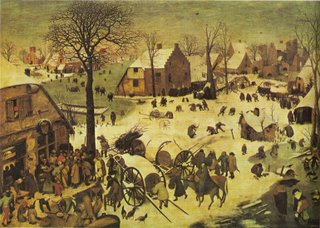
Yesterday, I have seen a BBC documentary about the Flemish painter Breughel (the older, 1525 – 1569). Some part of the documentary explained the idea of the painting "De Volkstelling" (counting of the population), and described all the different activities of the people in the painting and the playing children. The speaker of the documentary commented that this painting addresses a crucial human question: What is the meaning of it all? It was said that the achievement by Breughel regarding story telling, Breughel ranks maybe higher than Da Vinci, Rafael or Michelangelo.

Tuesday, December 12, 2006
France
So, there is always this magic gap between sensation and words that we use to describe certain experiences. I am thinking on wine right now, and the many regions in France where wine is produced. A quote from Daniel Dennett on speech: "Fully fledged and executed communicative intentions - Meanings - could emerge from quasi-evolutionary process of speech act design that involves collaboration, partly serial, partly in parallel, of various subsystems none of which is capable on its own of performing - or ordering - a speech act."
The semantics of wine might be related to the semantics processes that assign words to taste.
The semantics of wine might be related to the semantics processes that assign words to taste.
Wednesday, October 25, 2006
Symbols and their meanings
I am reading a book with very nice poetry on design and technology by John Maeda. The book addresses the pleasure which simplicity can provide in a complex world. Or, it addresses the important question on how to look at complexity and appreciate correct reduction of it.
One of the chapters in the book is called "more emotions, than less". It is stated that humans are disposed to communication with emotional content, and that we naturally try to express emotions. Maybe this is related to our strong instincts for attachments to people. Often, agreeing (or disagreeing) with ideas seems to be more important than the ideas themselves. (I think one can observe this phenomenon in schools for example. Agreeing with a teacher is often more helpful for ones career than trying to pursuit the understanding of ones own ideas. If this hypothesis is true, teachers have some important responsibility: Make their students learn to understand and build their own theories, and not to take theories because of reasons of attachment.)
John Maeda explains the use of the emotional symbols :-), ;-), :-p .And indeed, I once read the statement of a mathematician that he would like to use symbols in programming languages, greek letters to specify surfaces or volumes maybe. Because mathematicians, they transport a lot of information by the use of symbols. How forms in space can be changed to understand a process for example. Anyway, to understand symbols, there must be some form of compilation or interpretation that takes place. In computer science, interpretation is based on attributing symbols to categories, and return a value that corresponds with this state.
One of the chapters in the book is called "more emotions, than less". It is stated that humans are disposed to communication with emotional content, and that we naturally try to express emotions. Maybe this is related to our strong instincts for attachments to people. Often, agreeing (or disagreeing) with ideas seems to be more important than the ideas themselves. (I think one can observe this phenomenon in schools for example. Agreeing with a teacher is often more helpful for ones career than trying to pursuit the understanding of ones own ideas. If this hypothesis is true, teachers have some important responsibility: Make their students learn to understand and build their own theories, and not to take theories because of reasons of attachment.)
John Maeda explains the use of the emotional symbols :-), ;-), :-p .And indeed, I once read the statement of a mathematician that he would like to use symbols in programming languages, greek letters to specify surfaces or volumes maybe. Because mathematicians, they transport a lot of information by the use of symbols. How forms in space can be changed to understand a process for example. Anyway, to understand symbols, there must be some form of compilation or interpretation that takes place. In computer science, interpretation is based on attributing symbols to categories, and return a value that corresponds with this state.
Thursday, October 05, 2006
The stars and elements
Today, I obtained one of the most important books in human history so far. It's Euclids collections of observations about very simple elements: points and lines. My first observation is that only the introduction to this book is readable as a classical story. The introduction tells about the warm climate of the mediterranean, asks the reader to imagine flourishing agriculture and trading routes between small cities in the Nile delta 2400 years ago. Then, it tells about a city where the people gathered to discuss such things as navigation and architecture, the precursors of knowledge based industries maybe.
The first practical use of observing the stars was navigation on the sea, but the moving patterns and the wonder of small light points in an endless sky, certainly lead to more speculative questions about the hidden laws that make them and us move. Well, for Euclid, it might have lead to write a book about mathematics. Geometry is one of the origins of mathematics, and might teach us some good deal about problem solving. Euclid did not really mention what kinds of problems he wanted to solve. All he shows is how to prove that a proposal is true or false. He must have had quite some fun in discussing about design of reasoning with poets, sailors, artists, priests, kids ? I think the Alexandria of 300 B.C. might have been a place like this.

The first practical use of observing the stars was navigation on the sea, but the moving patterns and the wonder of small light points in an endless sky, certainly lead to more speculative questions about the hidden laws that make them and us move. Well, for Euclid, it might have lead to write a book about mathematics. Geometry is one of the origins of mathematics, and might teach us some good deal about problem solving. Euclid did not really mention what kinds of problems he wanted to solve. All he shows is how to prove that a proposal is true or false. He must have had quite some fun in discussing about design of reasoning with poets, sailors, artists, priests, kids ? I think the Alexandria of 300 B.C. might have been a place like this.

Sunday, September 24, 2006
Uffizi, tuscany and wine
Wow.
My last two weeks have been an amazing experience, not because I was swimming in days of joy and happiness, but because I could improve my insights of Jimi Hendrix quote "I don't mind". Of course I do, but once in a while it is important to realize, that we shouldn't.
It all started with a 6 hours jet-lag, a stop-over in Amsterdam, and an elevator which gains exclusive access to members only. Actually, the only important occurence was the elevator not accepting VISA cards, but only badges. The designers of the elevators did not take into account the decreasing mental abilities of old people, i.e. that they might have trouble of discerning between credit cards and access badges. So, the lift, didn't move, and the old user was frustrated. Now, the clever mind asks, how to design a better elevator ? First of all, the elevator certainly did not have any idea what kind of beings send a request for a transport service. It could have been mushroom cladded aliens. Anyway, the only way to fully authenticate oneself would be by reading your personal DNA structure. (I find this a great idea by the way.)
So, it took me some days to realize that there is an important connection between our DNA structure, and our personal ambitions, our feelings for pleasure and suffering, and our capabilities to communicate about this by using music, paintings, fashion, food, cars, black magic vodoo dolls, compasses, elevators etc. It is because we all take somehow part in effects of human minds, that we always try out new words and ideas, new forms of expressions. In some sense, we are programmed to do so, because our ancestors, and ancestors ancestors would have survived more easily by cultivating a sense for expression. Maybe what we express, are our most complicated and hidden structures from a design process that has been lasting since billions of years, and shows our most complex inner workings of our personal DNA structure ?
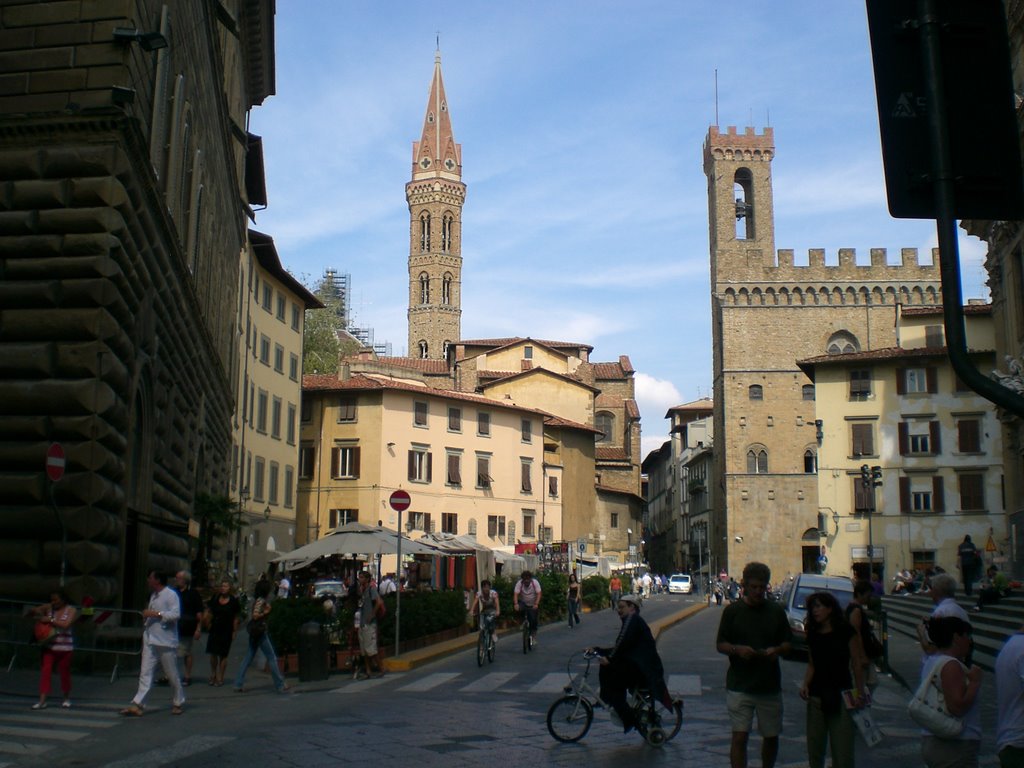
Anyway, you end up after escaping Napoli (which had good coffee, singing people, but the thread of being used by non-educated casa nostra people), and the bay of Naples (which is beautifull, but quite crowded with tourists), so - you end up walking in Tuscany in Val d'Orcia (where I had a great lunch, with Montepulciano read wine, taglietelle, escaloppe). The interesting thing is that I ended up walking alone there, realizing, that actually, the whole fact, that I can reflect about walking alone has been nothing else than a coincidence. But a very, very complicated one. Even more fascinating that I can tell you about this. A practical side-effect of this insight was that I was able to skip 2.5h waiting in a queue before the Uffizi galleries in Firenze. The only thing you have to do is to place yourself before Italian people, and hoping to meet english people with good common-sense...

My last two weeks have been an amazing experience, not because I was swimming in days of joy and happiness, but because I could improve my insights of Jimi Hendrix quote "I don't mind". Of course I do, but once in a while it is important to realize, that we shouldn't.
It all started with a 6 hours jet-lag, a stop-over in Amsterdam, and an elevator which gains exclusive access to members only. Actually, the only important occurence was the elevator not accepting VISA cards, but only badges. The designers of the elevators did not take into account the decreasing mental abilities of old people, i.e. that they might have trouble of discerning between credit cards and access badges. So, the lift, didn't move, and the old user was frustrated. Now, the clever mind asks, how to design a better elevator ? First of all, the elevator certainly did not have any idea what kind of beings send a request for a transport service. It could have been mushroom cladded aliens. Anyway, the only way to fully authenticate oneself would be by reading your personal DNA structure. (I find this a great idea by the way.)
So, it took me some days to realize that there is an important connection between our DNA structure, and our personal ambitions, our feelings for pleasure and suffering, and our capabilities to communicate about this by using music, paintings, fashion, food, cars, black magic vodoo dolls, compasses, elevators etc. It is because we all take somehow part in effects of human minds, that we always try out new words and ideas, new forms of expressions. In some sense, we are programmed to do so, because our ancestors, and ancestors ancestors would have survived more easily by cultivating a sense for expression. Maybe what we express, are our most complicated and hidden structures from a design process that has been lasting since billions of years, and shows our most complex inner workings of our personal DNA structure ?
Anyway, you end up after escaping Napoli (which had good coffee, singing people, but the thread of being used by non-educated casa nostra people), and the bay of Naples (which is beautifull, but quite crowded with tourists), so - you end up walking in Tuscany in Val d'Orcia (where I had a great lunch, with Montepulciano read wine, taglietelle, escaloppe). The interesting thing is that I ended up walking alone there, realizing, that actually, the whole fact, that I can reflect about walking alone has been nothing else than a coincidence. But a very, very complicated one. Even more fascinating that I can tell you about this. A practical side-effect of this insight was that I was able to skip 2.5h waiting in a queue before the Uffizi galleries in Firenze. The only thing you have to do is to place yourself before Italian people, and hoping to meet english people with good common-sense...
Monday, August 14, 2006
Art and Culture
from a newsgroup:
> I've cross posted this. In my experience a good artist can adopt several different styles of painting. If they use a certain style or explore a different technique will this mean that they are ' psychologically disturbed' ?
I think this question only make sense, if you give better concepts for "artist" and "the methods or style of the artists". Now, the question looks like you are assuming a Cartesian theater where "the artist" controls some part of his mind that then give a certain style to his work. The dualist view is misleading in questions related to the mind. Once you adopt a multiple-agent-viewpoint of the mind, you could argue that a good artist must be very sensitive to certain experiences, and
in turn, must be able to amplify these certain mental states (that are caused by the experiences directly in combinations with impressions from his long-term memories). Of course, we not always like to have certain mental states amplified, and in turn, our culture provides ways of thinking to avoid confrontation with them. On the other hand, good art often originates from the confrontation with average ways of
thinking. That is where your paradox comes from: On the one hand, it can be dangerous to leave safe cultural waters, on the other hand, it can be safe, no to stay in average cultural waters.
> I've cross posted this. In my experience a good artist can adopt several different styles of painting. If they use a certain style or explore a different technique will this mean that they are ' psychologically disturbed' ?
I think this question only make sense, if you give better concepts for "artist" and "the methods or style of the artists". Now, the question looks like you are assuming a Cartesian theater where "the artist" controls some part of his mind that then give a certain style to his work. The dualist view is misleading in questions related to the mind. Once you adopt a multiple-agent-viewpoint of the mind, you could argue that a good artist must be very sensitive to certain experiences, and
in turn, must be able to amplify these certain mental states (that are caused by the experiences directly in combinations with impressions from his long-term memories). Of course, we not always like to have certain mental states amplified, and in turn, our culture provides ways of thinking to avoid confrontation with them. On the other hand, good art often originates from the confrontation with average ways of
thinking. That is where your paradox comes from: On the one hand, it can be dangerous to leave safe cultural waters, on the other hand, it can be safe, no to stay in average cultural waters.
Subscribe to:
Posts (Atom)